

What is Mortgage Insurance?
CASAPLORERTrusted & Transparent
Mortgage insurance protects your mortgage lender should you default on your mortgage. While mortgage insurance only protects your lender, the cost of mortgage insurance is paid by you.


Why do you have to pay for insurance for your lender if it doesn’t protect you? Since mortgage insurance reduces the risk for your lender, you’ll be able to make a smaller down payment on your mortgage, get a better mortgage rate, and qualify for a mortgage that you might not have been approved for.
If you are looking to get insurance that protects you, such as if you pass away or become disabled and are unable to make your mortgage payments, then you would need mortgage protection insurance instead.

There are different types of mortgage insurance that varies depending on your loan type:
| Loan Type | Mortgage Insurance | Required? |
|---|---|---|
| Conventional Mortgage | Private Mortgage Insurance (PMI) | Required if down payment is less than 20% |
| FHA Loan | Mortgage Insurance Premium (MIP) | Required for all FHA loans |
| USDA Loan | USDA Mortgage Insurance | Required for all USDA loans |
| VA Loan | VA Funding Fee | Required, unless you qualify for exemptions, such as having a service-connected disability |
What is private mortgage insurance?
Conventional Loan Mortgage Insurance
Private mortgage insurance (PMI) covers conventional loans, which are loans that are not part of a government program. You'll need to get PMI if your down payment is less than 20%, or if you are refinancing your conventional loan with a loan-to-value (LTV) greater than 80%.
Once your mortgage has a LTV ratio of 80% or less, you can manually request to have your PMI removed. In order to stop having to pay PMI, you’ll need to make a request in writing to your lender. You will receive a refund for any premiums that you have paid upfront.
If you do not make a request, your PMI will automatically be cancelled once your LTV ratio is below 78% or once you are halfway through your loan’s amortization. For example, if your conventional loan has an amortization period of 30 years, your PMI will be cancelled after 15 years, even if your LTV is still above 78%, such as if your loan was interest-only for a portion of your term.
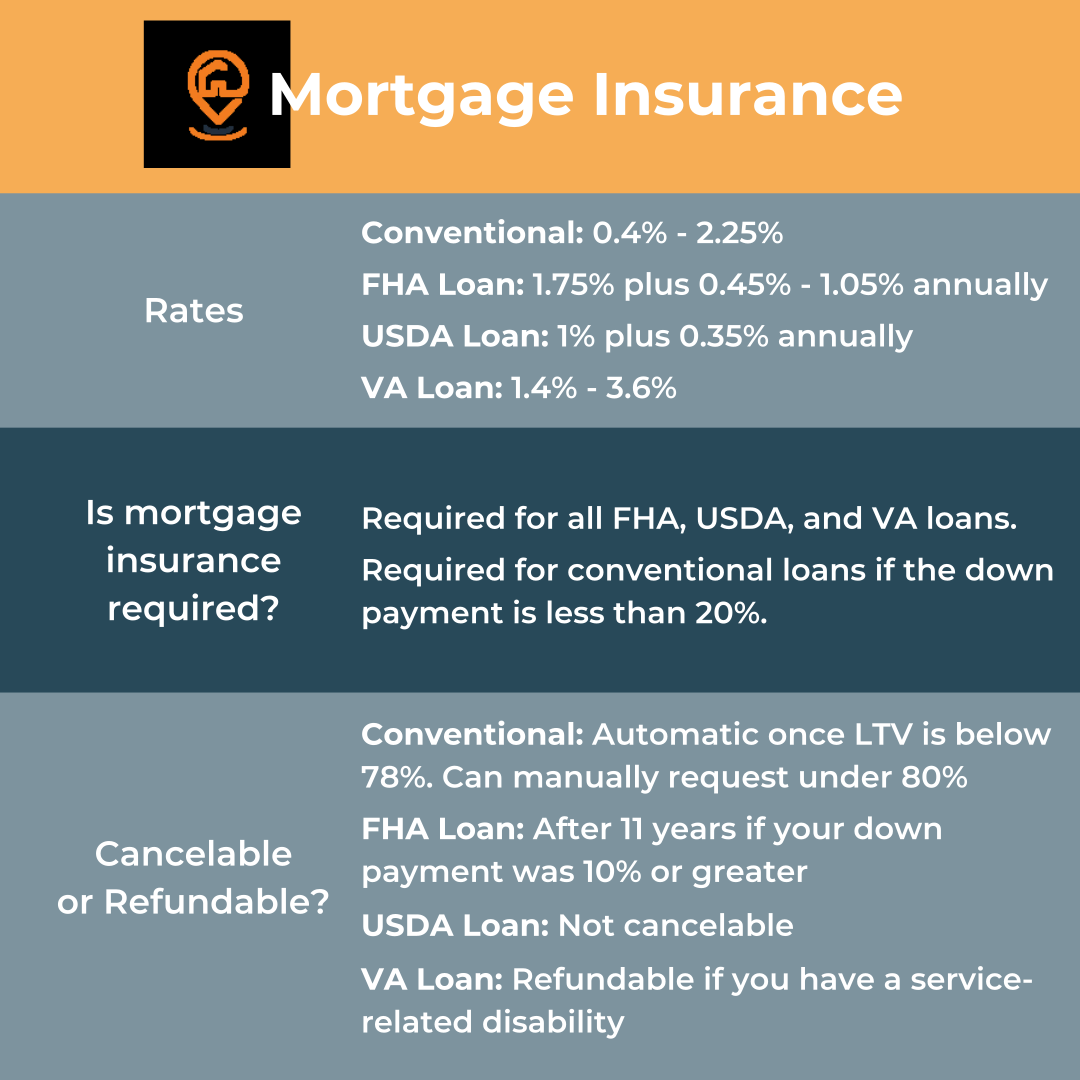
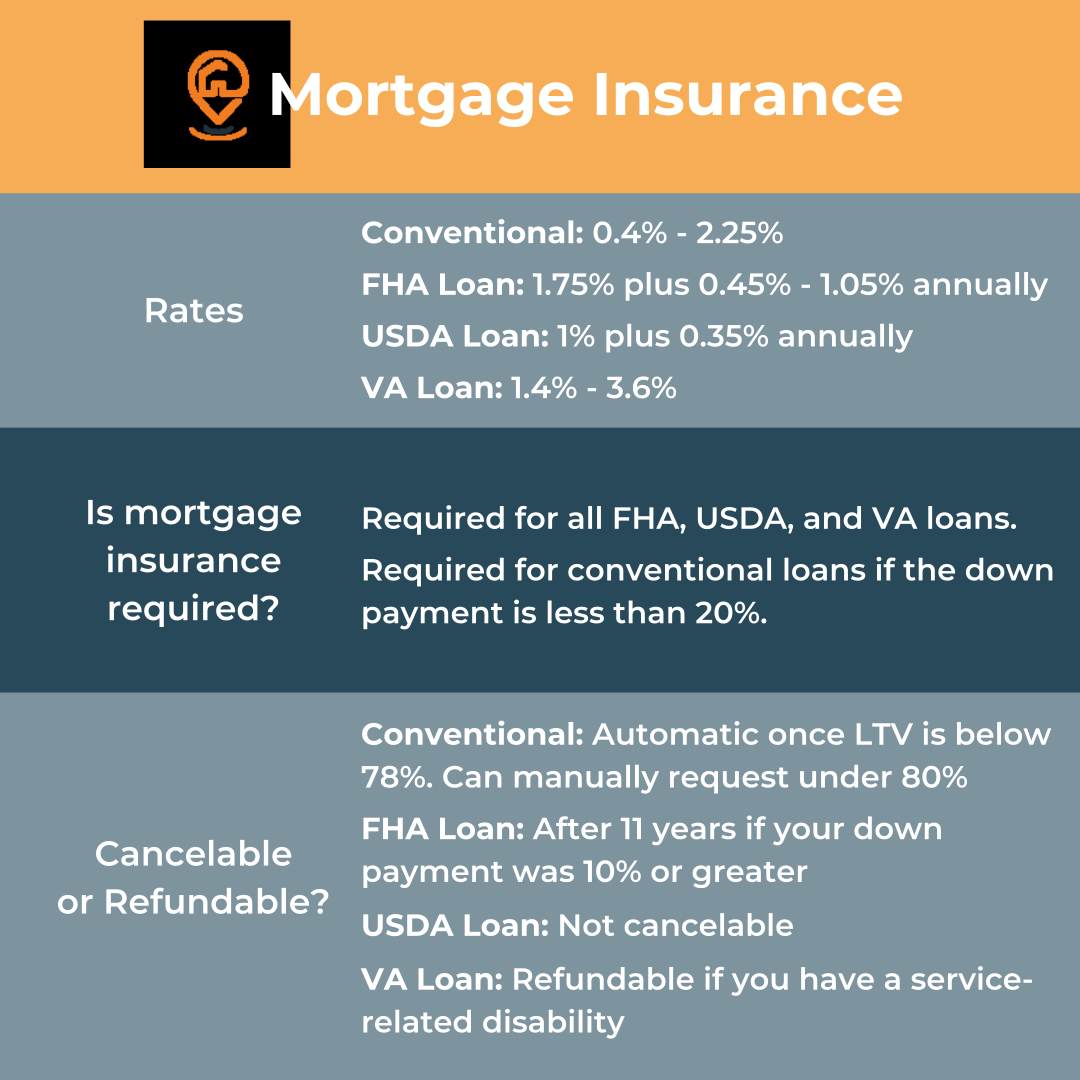
PMI premiums are a percentage of your home loan amount. PMI rates can range from 0.4% to 2.25% of your loan amount. To calculate how much your monthly PMI payments and total PMI will be, visit our PMI calculator.
There are four types of ways that private mortgage insurance can be paid:
Types of Private Mortgage Insurance
| PMI Type | Payment Structure | Monthly Payment? | Upfront Cost? |
|---|---|---|---|
| Borrower-Paid Mortgage Insurance (BPMI) | You will pay this as a monthly fee added onto your monthly mortgage payments. | Yes | No |
| Single-Premium Mortgage Insurance (SPMI) | You will pay this as upfront at closing, or you can add it onto your mortgage balance. | No | Yes |
| Lender Paid Mortgage Insurance (LPMI) | The lender pays, but you'll indirectly pay through a higher interest rate. | No | No |
| Split-Premium Mortgage Insurance | Pay a portion upfront, with the remainder being added as monthly payments. | Yes | Yes |
USDA Mortgage Insurance
Just like FHA mortgage insurance, USDA mortgage insurance has both an upfront fee and an annual fee that is added to your monthly mortgage payments. All USDA loans require USDA mortgage insurance, whether you make a zero down payment (100% financing) or make a larger down payment. USDA mortgage insurance premiums are called guarantee fees.
USDA's upfront guarantee fee, also known as the USDA funding fee, is 1% of your loan amount. This upfront fee is added to your loan amount, paid in full at closing, or partially paid with the remaining added onto your loan. The annual guarantee fee is 0.35%, which is paid monthly as part of your mortgage payments.
Unlike conventional PMI and FHA MIP, USDA mortgage insurance can not be removed or cancelled. In exchange, USDA mortgage insurance rates are much lower compared to PMI and MIP. To see if you’re eligible for an USDA loan, visit our USDA loan eligibility map.
USDA Funding Fee 2021
| Upfront Guarantee Fee | 1% of loan amount |
|---|---|
| Annual Guarantee Fee | 0.35% of loan amount |
VA Loan Funding Fee
VA loans are partially backed by the U.S. Department of Veterans Affairs. Instead of mortgage insurance, you'll have to pay for this VA guarantee. All VA loans have a VA funding fee, which is an upfront payment that is either paid in full at closing or added to your loan.
VA funding fees can range from 1.4% to 3.6% of your loan amount and loan type. You won't have to pay the VA funding fee under some circumstances, such as if you have a service-connected disability and are eligible or receiving VA compensation. You might also receive a VA funding fee refund if you later become exempt from the funding fee. To learn more about VA loans, visit our VA loans page, our VA loan rates page, or ourVA loan payment calculator.
VA Funding Fee 2021
| VA Loans | VA Cash-Out Refinancing Loan | |||
|---|---|---|---|---|
| Down Payment | VA Funding Fee | Down Payment | VA Funding Fee | |
| First Use | Less than 5% | 2.3% | Any | 2.3% |
| 5% or more | 1.65% | |||
| 10% or more | 1.4% | |||
| After First Use | Less than 5% | 3.6% | Any | 3.6% |
| 5% or more | 1.65% | |||
| 10% or more | 1.4% |
What is mortgage protection insurance?
Mortgage protection insurance, also known as mortgage life insurance, is a type of insurance that covers your mortgage should you pass away or become disabled. Since mortgage protection insurance covers your mortgage amount, this means that the maximum amount of the insurance benefit will decrease over time as you make mortgage payment.
Mortgage protection insurance claims are paid out to your mortgage lender to pay off your mortgage. Your beneficiaries might not receive any money under this type of insurance.
Is mortgage insurance premiums tax deductible?
While this deduction was available in previous years, it has only been extended to the 2020 tax year. Upfront mortgage insurance premiums are tax deductible if you itemize your tax deductions when filing your income taxes, rather than using the standard tax deduction.
If your adjusted gross income(AGI)(which is your total income minus deductions) is less than $100,000, you can claim the entire amount of your mortgage insurance premiums. If your AGI is between $100,000 and $109,000, the deduction is reduced, with no deduction allowed if your AGI is over $109,000.
You will only be able to deduct upfront premiums, rather than monthly premiums, and you will also have to spread this upfront premium over 84 months or your mortgage term length, whichever is shorter.
Tax Deductions: An Example
For example, if your upfront mortgage insurance premium was $10,000 for a loan term of 30 years, you will need to spread this upfront cost over 84 months (7 years).
Itemized Tax Deduction = $10,000 / 7 years = $1,428.57
You will be able to claim a tax deduction of $1,428.57 per year for a maximum of seven years if your AGI is less than $100,000 and if the tax deduction is in force for your tax year.